
That story isn’t unusual. Payroll mistakes in Canada are one of the fastest ways to trigger CRA penalties, and most of them don’t start with bad intentions.
They start with outdated spreadsheets, unclear worker classifications, missed deadline reminders, and payroll records that don’t match accounting records.
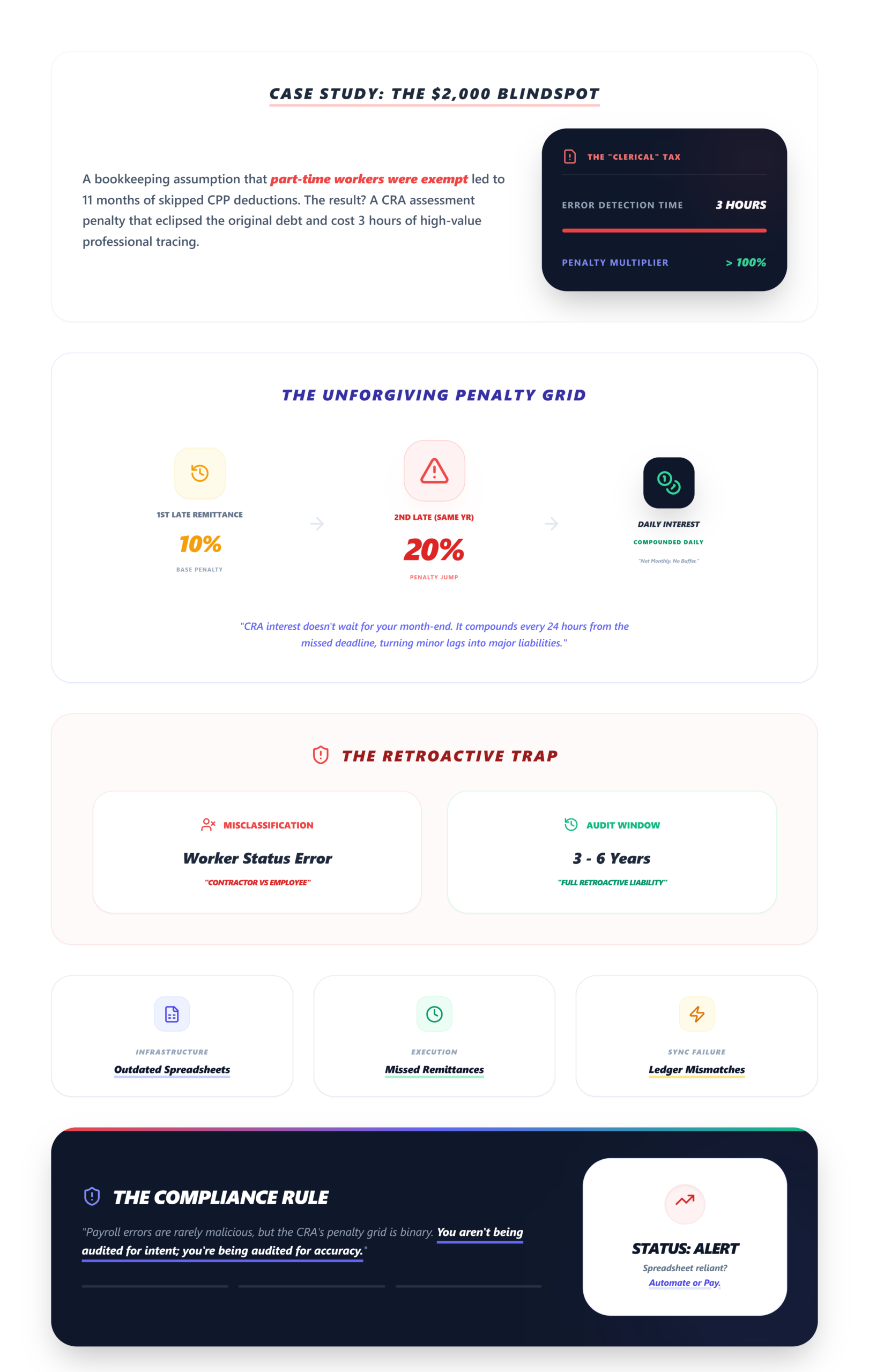
CRA’s penalty grid is unforgiving. A first late remittance hits you with 10%. A second one in the same calendar year jumps to 20%.
Interest compounds daily, not monthly. And misclassification errors can trigger retroactive assessments going back three to six years.
This guide covers the most common payroll errors Canadian businesses and accounting firms encounter, why they lead to penalties, and exactly how to prevent them.
1. Incorrect Employee Classification
Misclassifying a worker as an independent contractor when they’re legally an employee is one of the most expensive payroll mistakes in Canada.
CRA uses a four-part test—control over work, ownership of tools, chance of profit or loss, and degree of integration—to determine worker status.
Failing that test triggers retroactive CPP and EI assessments, plus penalties.
What This Looks Like Operationally
A business hires a “contractor” who works on-site, uses company equipment, follows a set schedule, and reports to a manager. That arrangement fails three of four CRA criteria. The business doesn’t withhold source deductions. Three years later, a CRA payroll audit catches it.
The consequences:
- Retroactive CPP/EI assessments for every year the worker was misclassified
- Failure-to-deduct penalties at 10% of the amount that should have been withheld
- Back taxes and daily compounding interest on the unpaid amounts
- Potential director liability for trust fund violations, which isn’t dischargeable in bankruptcy
A misclassification discovered in 2026 can mean reassessments for 2023–2025. Depending on salary levels, that’s $75K or more in back taxes for a single worker.
Conduct an annual worker classification audit using CRA’s control test. Document the decision for every contractor relationship in writing. If the classification is borderline, get a CPT1 ruling from CRA before the engagement starts. Don’t rely on the worker’s preference or a contract title—CRA looks at the actual working relationship.
2. Missing Payroll Filing and Remittance Deadlines
Late payroll remittances are the most straightforward way to trigger CRA payroll penalties. Source deductions—income tax, CPP, and EI—must be remitted according to your assigned remitter type.
Missing that deadline by even a few days starts the penalty clock.
CRA’s Escalating Penalty Structure
- 1–3 days late: 3% Penalty Rate
- 4–5 days late: 5% Penalty Rate
- 6–7 days late: 7% Penalty Rate
- 8+ days late: 10% Penalty Rate
- Second failure in same year: 20% Penalty Rate
On top of that, interest accrues daily at the prescribed rate (currently prime + 4%). A $50,000 late remittance sitting unpaid for 30 days can generate over $1,200 in interest alone.
T4 slips must be filed by the last day of February. Late T4 filing carries its own penalty: $100 for the first day, then $25 per day for each day after, up to 100 days.
Why Deadlines Get Missed
The most common cause isn’t carelessness. It’s remitter type misalignment.
CRA assigns your remitter type—regular, quarterly, or accelerated—based on your average monthly withholding amount. If your business grows and CRA reclassifies you as an accelerated remitter but you’re still remitting monthly, the system flags it automatically.
Another common cause: payroll and accounting operate in disconnected systems. The payroll run happens, but the remittance instruction doesn’t flow to the person making the payment. Or the payment is made but the confirmation isn’t stored, and CRA assumes non-payment.
How to prevent it:
- Set a calendar reminder 60 days before fiscal year-end to confirm your remitter type letter from CRA
- Store remittance confirmations and bank payment receipts in the same cloud folder with date stamps
- Verify CRA’s “My Business Account” shows “Payment Received” within one business day of remittance—if it still shows “Outstanding” after three days, investigate immediately
3. Incorrect CPP, EI, and Income Tax Deductions
Calculating source deductions incorrectly—whether CPP contributions, EI premiums, or income tax withholding—is a common payroll compliance issue in Canada.
CRA expects deductions to match current statutory rates, and those rates change every January 1.
The problem is straightforward: CPP and EI contribution rates update annually. If your payroll software doesn’t auto-sync those changes, or if you’re running payroll from spreadsheets, you’ll underpay or overpay deductions across your entire employee base.
One missed rate update on January 1 across 50 employees can create a $2,000+ shortfall by year-end. That shortfall shows up as a mismatch during T4 reconciliation—and it means amending T4 slips for every affected employee.
Common causes of deduction mistakes:
- Outdated deduction tables in manual payroll systems
- Part-time employees incorrectly excluded from CPP (CPP applies once earnings exceed $3,500/year)
- Tipped income not included in EI insurable earnings calculations
- Taxable benefits like company vehicles or tuition reimbursements not factored into withholding calculations
A client who doesn’t report a company car as a taxable benefit can have $8,000 or more in unreported income flagged during a CRA audit.
Create a “Rate Update Checklist” every December 15. Before the first January payroll run, manually verify that CPP rates, EI rates, and tax withholding tables are current. Build a CPP eligibility matrix by employee type and run a quarterly audit to catch missed deductions. For tipped workers, maintain a separate tipped income log and reconcile it to T4 Box 14 monthly.
4. Poor Payroll Record Keeping
CRA requires payroll records to be maintained for six years.
Incomplete records, missing documentation, or disorganized files create serious problems during a CRA payroll audit. If you can’t produce remittance proof, CRA assumes non-payment and assesses penalties plus interest.
This isn’t theoretical. Firms that lose remittance receipts for a single quarter face the burden of proving payment was made. Without bank confirmations or CRA receipts, the default position works against you.
What “poor records” actually means in practice:
- Missing timesheets for hourly employees
- No signed employment contracts or contractor agreements on file
- Payroll summaries that don’t tie to bank transactions
- Supporting documentation stored across multiple locations with no consistent naming convention
- No record of taxable benefit valuations
Why it matters beyond audits:
Poor payroll record keeping makes reconciliation nearly impossible. When records are incomplete, month-end close takes longer, errors compound, and financial statements become unreliable. The downstream effect touches everything from tax preparation to financial reporting accuracy.
Implement a cloud-based filing system where every payroll run generates a folder containing the payroll summary, remittance confirmation, bank payment receipt, and any supporting documents. Create a “Taxable Benefit Checklist” at hire. Use CRA’s valuation guide and document benefit values in each employee file.
5. Payroll and Accounting Records Don’t Match
This is where most payroll tax mistakes become financial reporting problems.
When payroll records and accounting records don’t reconcile, you get duplicate entries, payroll-to-ledger mismatches, and inaccurate financial statements. It’s the single biggest operational gap in many Canadian firms.
The issue usually starts with disconnected systems. Payroll runs in one platform. Accounting lives in another. Bank transactions sit in a third. Nobody reconciles them until month-end—and by then, the mismatches have compounded.
What this looks like:
- T4 Box 14 (gross pay) shows $52,000 but payroll records show $55,000
- Payroll remittances recorded in the ledger don’t match CRA payment confirmations
- Duplicate T4 slips generated from manual re-entry or system glitches
- Payroll journal entries that don’t tie to actual bank debits
A Box 14 mismatch is a red flag for CRA. They assume underreporting and trigger a deeper audit. Duplicate T4s cause CRA to reject the entire filing and demand corrections within 30 days.
The downstream impact:
Month-end close becomes a reconciliation nightmare. Tax preparation relies on financial statements that don’t reflect reality. Financial visibility drops. Decision-making suffers.
Many firms only discover these discrepancies during year-end reconciliation, when fixing them is far more time-consuming and expensive.
Cleaner Reconciliation, Fewer Surprises.
When payroll data flows into clean, categorized financial records, reconciliation issues surface early—not at year-end. Platforms like LedgerNext help accounting firms maintain clean bookkeeping workflows by automating transaction categorization and reconciliation, so payroll-to-ledger mismatches don’t go unnoticed for months.
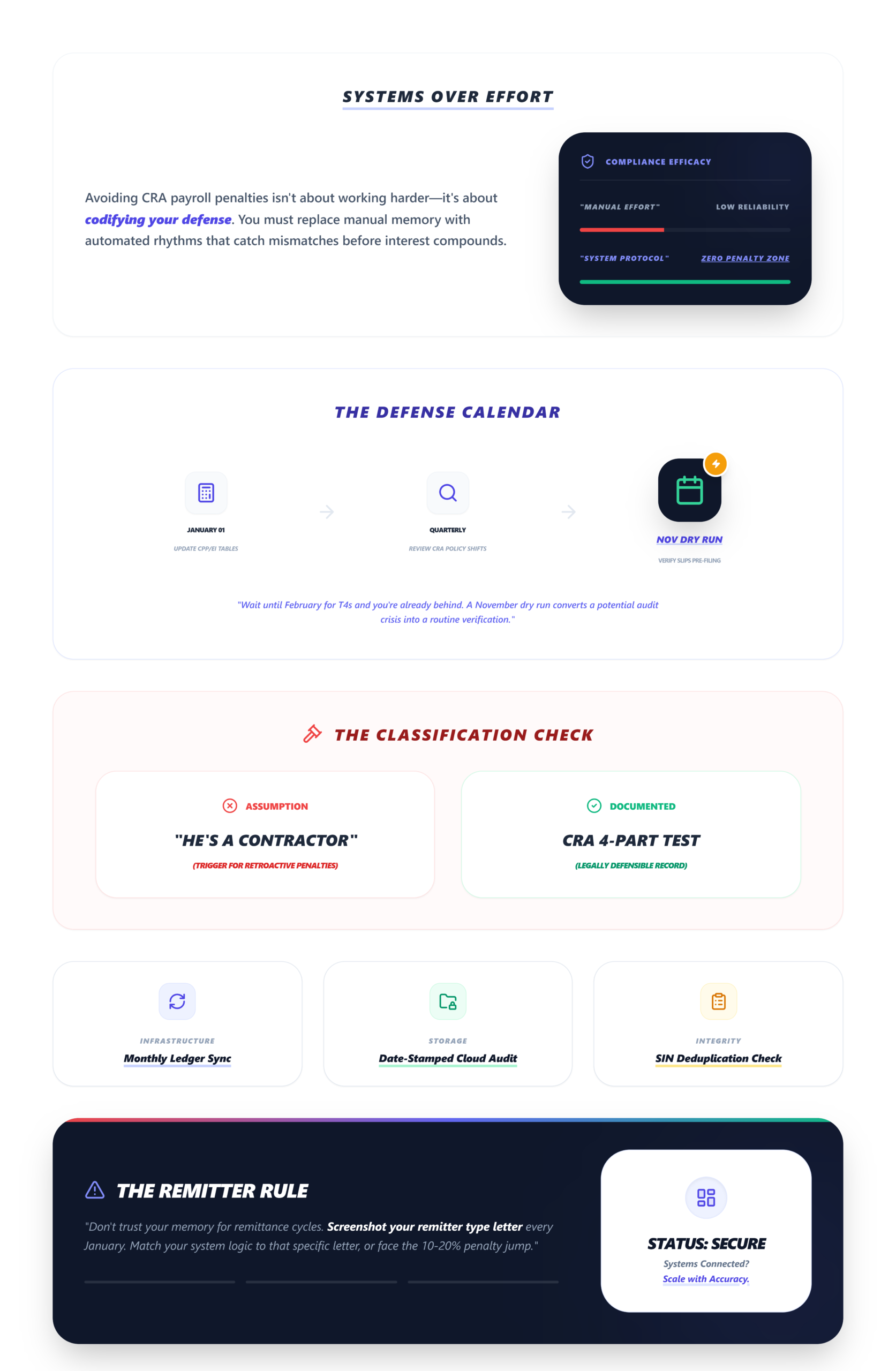
Run a “T4 Dry Run” in November. Manually spot-check 10 employee T4s against payroll records before final filing. Implement a T4 deduplication report—filter by SIN and employee name to catch duplicates before submission. Reconcile payroll journal entries to bank transactions monthly, not quarterly.
6. Manual Payroll Workflows Increase Risk
Spreadsheets, manual data entry, and fragmented workflows are behind most of the errors described above. Manual payroll processes don’t scale. They introduce human error at every step—data entry, calculation, remittance tracking, record storage, and reconciliation.
When a firm manages payroll for 5 employees, a spreadsheet might work. At 25 employees, the cracks show. At 50+, manual workflows become a compliance liability.
Common operational problems with manual payroll:
- Rate updates missed because there’s no automated sync
- Deduction calculations done by formula, with no built-in validation
- Remittance tracking dependent on one person’s memory or calendar
- Records scattered across local drives, email attachments, and filing cabinets
- No audit trail for changes or corrections
Every manual touchpoint is a potential payroll error. And every payroll error is a potential CRA penalty.
Standardize payroll workflows with documented procedures. Automate repetitive tasks—deduction calculations, remittance scheduling, record filing. Centralize payroll data so it’s accessible, auditable, and connected to your accounting workflow. The goal isn’t perfection on every payroll run. It’s building a system where errors surface quickly and corrections happen before CRA notices.
How to Avoid CRA Payroll Penalties
Prevention comes down to systems, not effort. Here’s a practical checklist:
- Verify deduction rates annually. Update CPP, EI, and tax withholding tables before the first January payroll run.
- Confirm your CRA remitter type. Check your remitter type letter every year. Screenshot it. Match it to your actual remittance schedule.
- Reconcile payroll to your ledger monthly. Don’t wait for year-end. Monthly reconciliation catches mismatches early.
- Automate repetitive calculations. Remove manual formulas wherever possible. Use validated payroll systems.
- Maintain organized, cloud-based records. Every payroll run should produce a complete, date-stamped folder.
- Run a T4 dry run in November. Spot-check employee slips against payroll records before final filing.
- Conduct annual worker classification reviews. Document every contractor relationship using CRA’s four-part test.
- Review CRA updates quarterly. Rate changes, deadline shifts, and policy updates affect compliance.
- Implement a deduplication check. Filter T4 submissions by SIN before filing to prevent duplicate slip rejections.
- Connect payroll data to your financial reporting workflow. Disconnected systems create reconciliation gaps that compound over time.
FAQs
What happens if you miss a payroll remittance deadline in Canada?
CRA charges penalties starting at 3% for remittances 1–3 days late, escalating to 10% at 8+ days. A second late remittance in the same calendar year incurs a 20% penalty. Interest compounds daily at the prescribed rate (prime + 4%), which can significantly increase the total amount owed.
How long does CRA require you to keep payroll records?
CRA requires all payroll records—including timesheets, T4 slips, remittance confirmations, and employee documentation—to be retained for a minimum of six years. If records are missing during an audit, CRA may assume non-compliance and assess penalties accordingly.
Can CRA reassess payroll errors from previous years?
Yes. CRA can issue retroactive assessments going back three to six years. Misclassification errors are particularly costly because retroactive CPP and EI assessments apply to every year the worker was incorrectly classified, plus penalties and daily compounding interest.
How do you prevent CPP deduction mistakes for part-time employees?
CPP contributions are required once an employee’s annual earnings exceed $3,500, regardless of part-time or full-time status. Build a CPP eligibility matrix by employee type and audit it quarterly. This catches missed deductions before they become year-end filing problems.
Why do payroll and accounting records often not match?
Payroll-to-ledger mismatches typically occur when payroll, banking, and accounting systems are disconnected. Journal entries don’t tie to bank debits, or payroll summaries don’t reconcile to T4 totals. Monthly reconciliation—rather than annual—is the most effective prevention strategy.
Conclusion
Payroll mistakes in Canada are rarely dramatic. They’re quiet—a missed rate update, a classification assumption, a remittance confirmation that wasn’t saved.
But CRA’s penalty structure turns small errors into expensive problems. A 10% penalty here, daily compounding interest there, a retroactive assessment that reaches back three years.
The pattern behind most of these issues is the same: disconnected data, manual processes, and reconciliation that happens too late. When payroll records, bank transactions, and accounting ledgers operate in silos, errors compound silently until they surface as CRA notices.
Clean financial data isn’t just about compliance. It’s about operational visibility—knowing your numbers are accurate before someone else checks them.
Modern reconciliation and accounting workflow automation reduce the manual touchpoints where errors enter the system and help surface discrepancies early, when they’re still easy to fix.
The firms that avoid CRA payroll penalties aren’t necessarily doing more work. They’re doing the right work, in the right order, with systems that catch problems before they escalate.
Stop Reconciling Payroll Manually.
If you’re still hunting for mismatched deductions and manually tying payroll runs to your ledger, see what your pipeline looks like when it’s automated end to end.
✅ Catch Payroll Mismatches Early
✅ Audit-Ready Financial Reports